From Demo to Real
Designing an intentional transition: a clear UX moment that helps users move from a risk-free demo to a consequential real-world environment without fear or confusion.
- Company
- Stealth
- Role
- Senior Product Designer
- Team
- Product
- Timeline
- 1 week
- Platform
- Mobile app
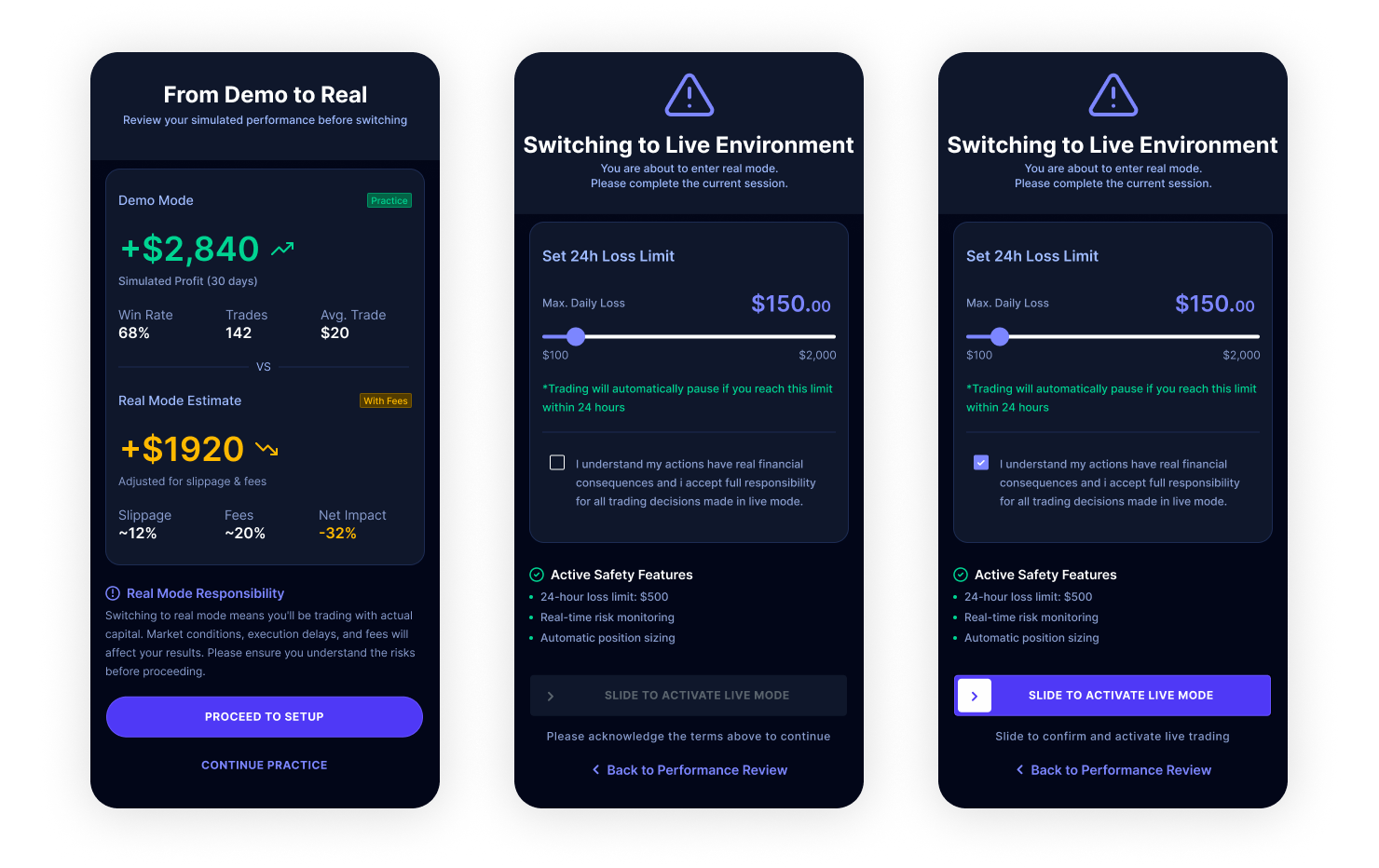
The goal
Facilitate an intentional decision, not an impulsive one.
01
Problem Statement
What was the core problem?
Moving from a risk-free demo to a live trading account is one of the most consequential moments in the product. In demo, mistakes cost nothing. In live mode, every action has real financial consequences.
The core risk was a mode error: a user carrying demo habits and demo confidence into an environment where the stakes are real, without fully registering that anything has changed.
The objective was to design a clear UX moment that helps users move from a risk-free demo to a consequential real-world environment without fear or confusion.
02
Context & Constraints
Product context, limitations, user types, environment
Goals and tasks
- Goal: understand why and when to switch.
- Goal: acknowledge the higher responsibility and risk while staying calm.
- Task: review performance metrics and calibrate live-trading guardrails.
Constraints
Regulatory compliance for risk warnings, and the mandatory friction of KYC flows. Neither could be designed away, so the experience had to work with them rather than around them.
Requirements
The UI had to be transparent, respectful, and prevent impulsive behavior.
Assumptions
The user has reached a competency milestone in demo mode before the switch is triggered.
03
Research & Insights
What you discovered through research
To design a clear and intentional transition from demo mode to real-world finance, we needed to understand what creates hesitation, confusion, or impulsive behavior at this moment.
Methods and participants
- Interviews with demo-only users, first-time depositors, and experienced traders
- Observations of user behavior during the transition moment
- Conversations with support agents about common fears and misunderstandings
This helped us identify emotional and cognitive patterns that influence decision-making.
Key insights that shaped the work
1. Users didn't understand the risk boundary
Many assumed real money behaved exactly like demo mode.
Design impact: we needed a clearer, more explicit shift that signals real-world consequences.
2. Fear came from uncertainty, not risk
Users were unsure what would happen next: fees, protections, limits.
Design impact: prioritize clarity and predictable steps over persuasion.
3. Impulsive switches were triggered by excitement
Users often moved to real money after a win in demo mode.
Design impact: reduce emotional triggers and add friction that supports intentional decisions.
What surprised the team
- Users trusted the demo environment more than the brand.
- Some believed the platform would protect them in real mode.
- Emotional state mattered more than financial knowledge.
04
Ideation & Exploration
How you explored potential solutions
Strategic approach: positive friction
Most product funnels are built to remove every step between intent and action. Here, that would have been the wrong goal. Instead of optimizing for speed, I explored where friction could do useful work: slowing the user down at the exact points where a considered decision matters most.
The trade-off was deliberate: positive friction over a high-speed conversion funnel, to keep the design ethical.
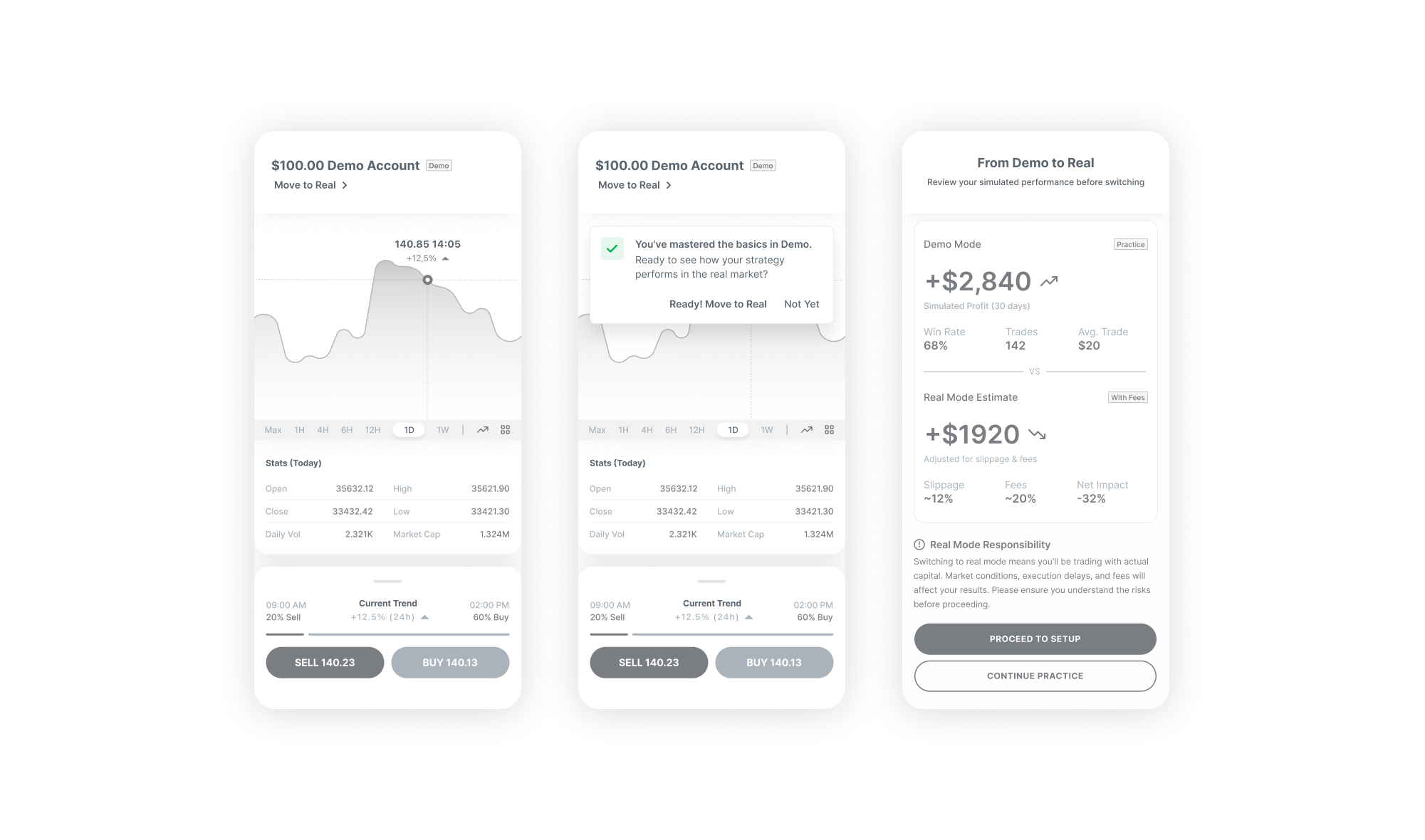
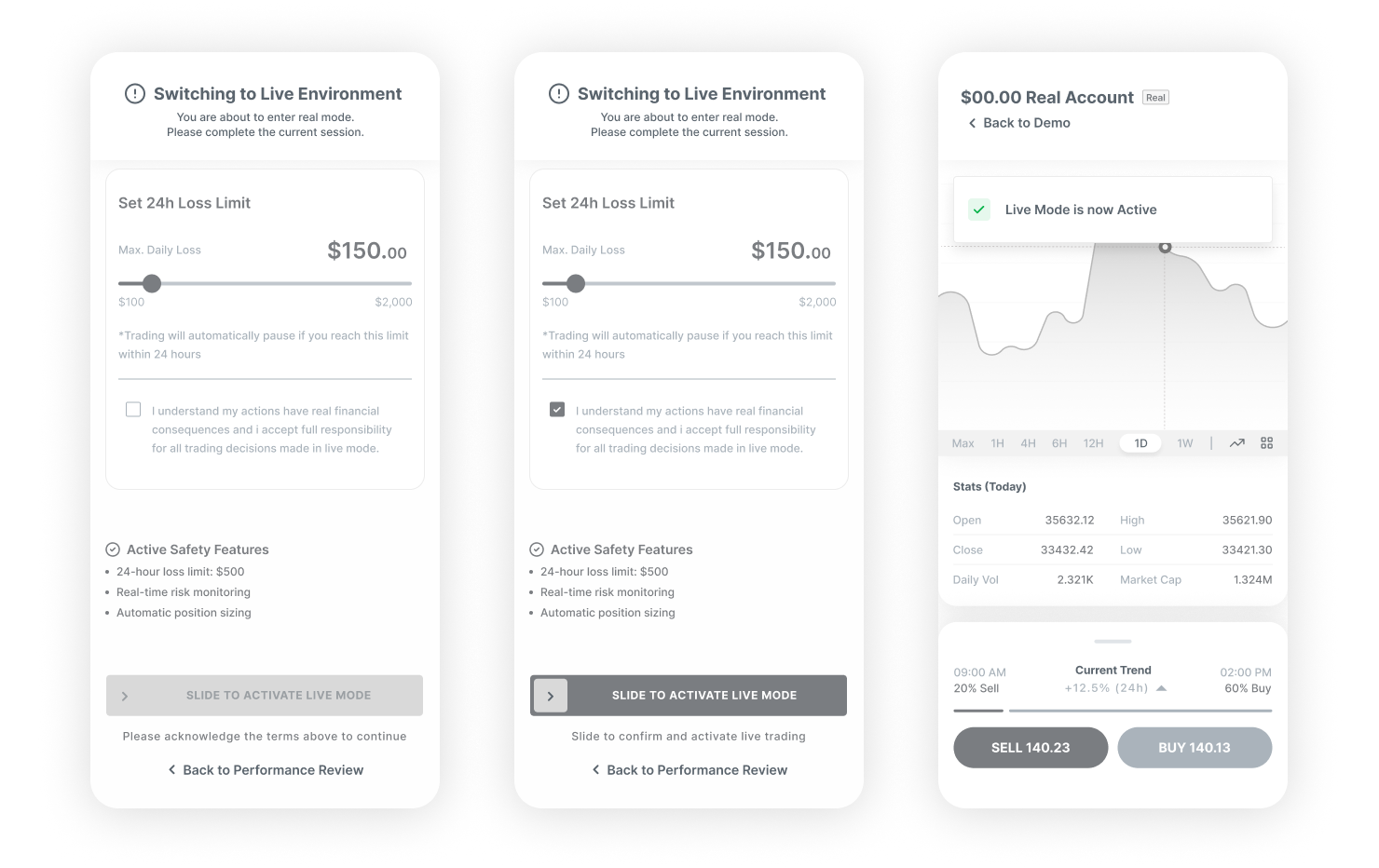
Mapping the flow
The wireframes map the full journey, from the demo account to the first moment in live mode.
05
Design Decisions
Why you chose the specific solution and what guided your decisions
Every decision was measured against one guide rail: acknowledge the risk while staying calm and transparent.
Clarity and safety over a shorter funnel
I prioritized clarity and safety over a shorter conversion funnel. A faster flow would convert sooner, but speed was never the measure of success here. The extra steps exist to turn a switch into a decision.
How the requirements shaped the screens
- Transparent: the performance review sets the demo results next to a real mode estimate adjusted for slippage and fees, so expectations are honest before any money is at stake.
- Respectful: there is always a way out. Not Yet, Continue Practice and Back to Performance Review stay visible, and the language stays factual rather than alarming.
- Prevents impulsive behavior: live mode can only be activated after an explicit acknowledgment, and with a slide gesture rather than a single tap.
- Compliant by design: the risk warning is part of the flow itself, written in plain language, rather than a block of legal text to scroll past.
06
The Solution
What shipped, and how it works
The final solution is built on three parts.
1. Why and when: the triggers
The switch is offered once the user reaches a competency milestone in demo mode. The prompt is an invitation, not a push: Ready! Move to Real sits next to an equally clear Not Yet. Before anything changes, the user reviews their simulated performance against a realistic estimate of how it would look in the live market.
2. How: the Air-Lock Gateway
Like an air-lock, the gateway is a distinct space between two environments. The user sets their guardrails, confirms that they understand their actions have real financial consequences, and only then can slide to activate live mode. Until the acknowledgment is checked, the slider stays disabled and says why.
3. The safety net: a 24h loss limit
Before going live, the user sets a maximum daily loss, from $100 to $2,000. If they reach it within 24 hours, trading pauses automatically. Active safety features, including real-time risk monitoring and automatic position sizing, are listed right above the activation control.
07
Outcome & Impact
What changed as a result of the solution (metrics, feedback, business impact)
The redesigned transition moment helped users move from demo mode to the real financial environment with greater clarity and confidence. By making the shift more intentional and less emotionally driven, we saw measurable improvements in user behavior and platform trust.
Key outcomes
- Increase in intentional transitions: more users completed the move to real money after reviewing the new clarity steps, rather than switching impulsively.
- Reduction in confusion-related support tickets: users reported fewer questions about fees, protections, and what changes between demo and real mode.
- Higher trust signals: users described the transition as clear, predictable, and less scary, indicating stronger alignment with real-world expectations.
Impact on the product
- The platform gained a more reliable onboarding funnel for real-money users.
- The team shifted from focusing on persuasion to focusing on decision quality, improving long-term user retention.
- The new flow created a foundation for future risk-related education moments across the product.